Objective
aicpp contains a learned program transformer.
We investigate whether the resulting embedding space exhibits structured organization beyond superficial syntactic similarity.
Experimental setup
- 9,998 programs
- model trained on more 100 target programs
- embedding dimension: 256
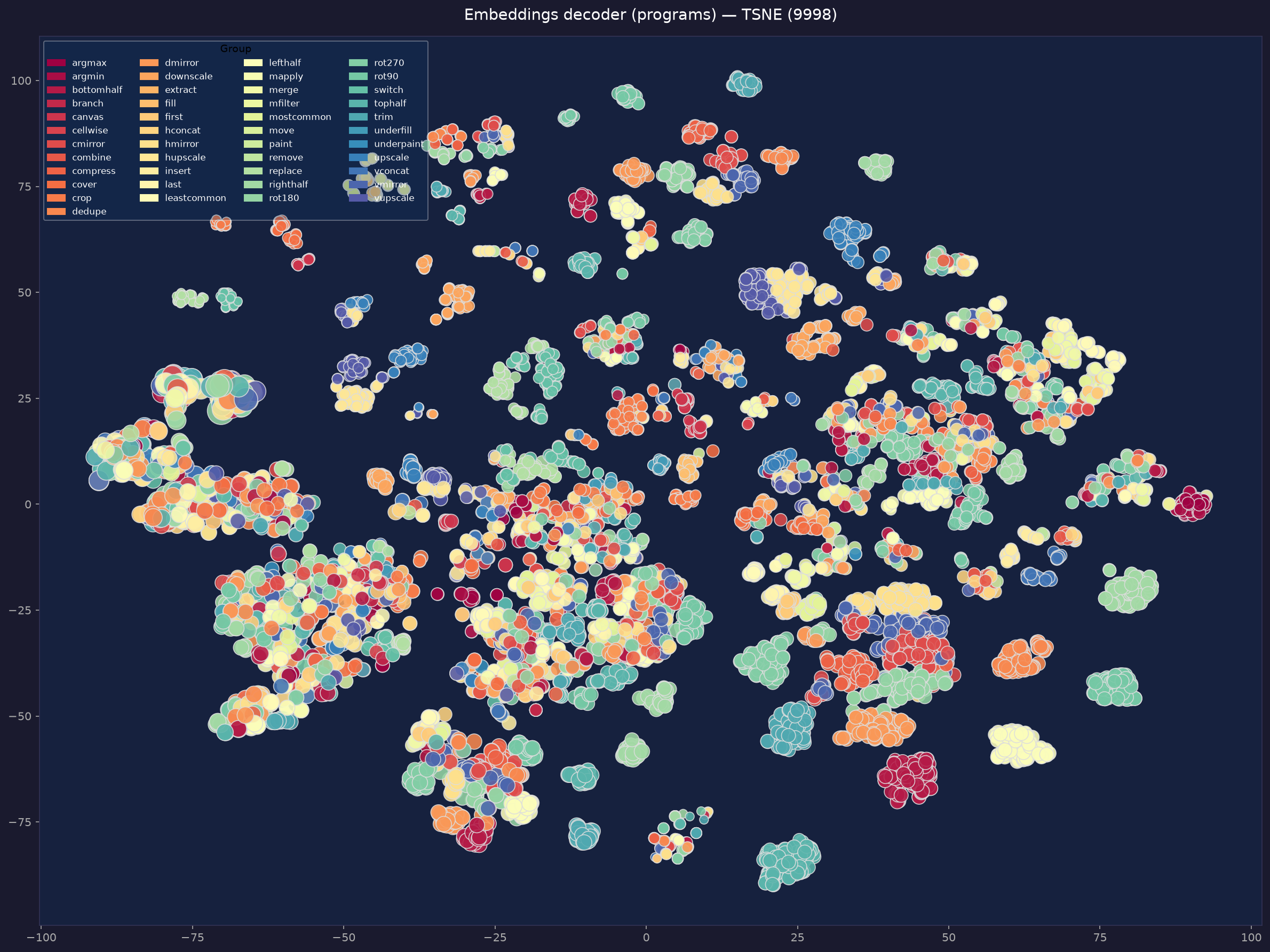
- t-SNE
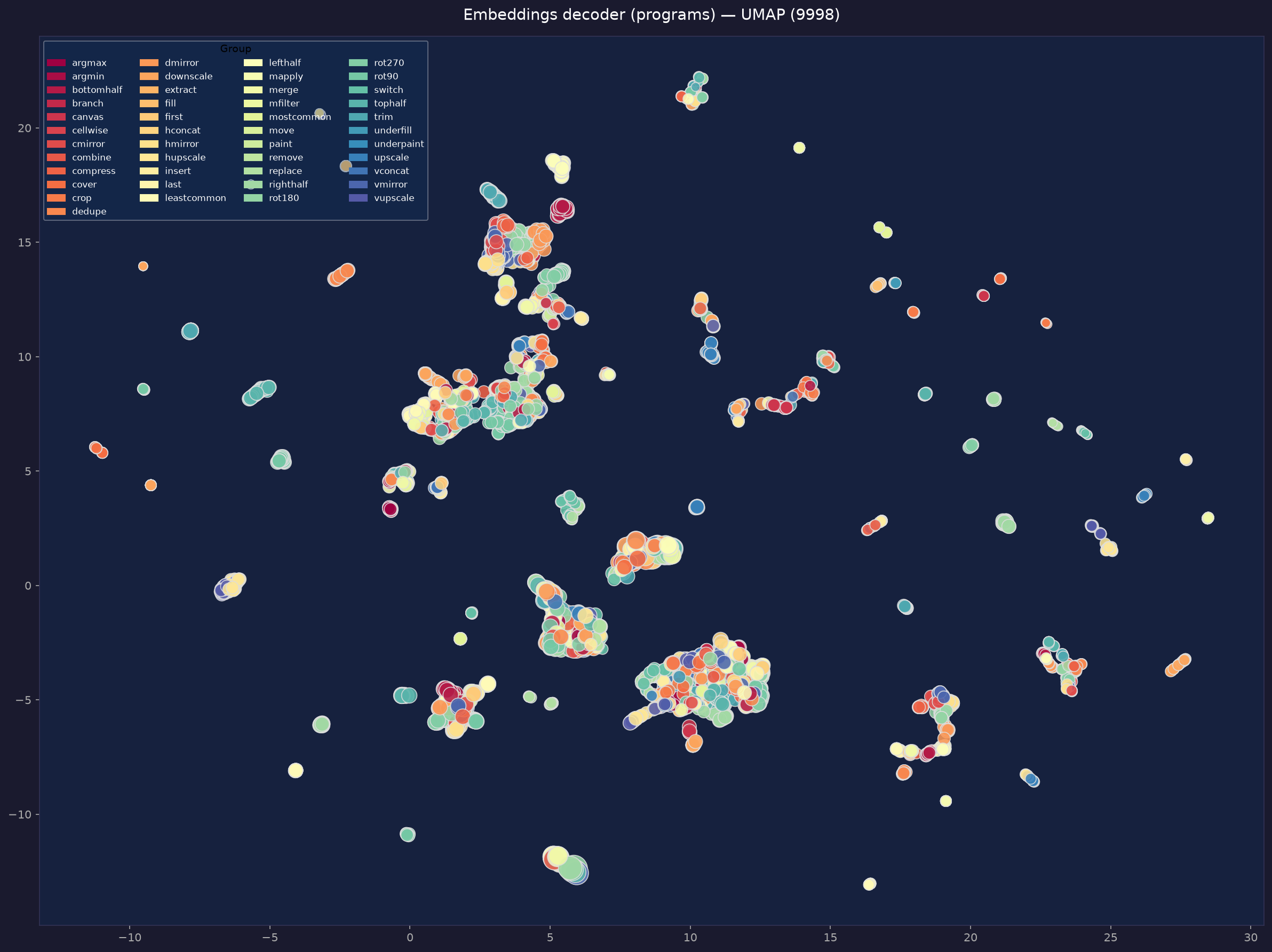
- UMAP
t-SNE
UMAP
Preliminary observation
Both projections reveal multiple structured regions in the learned program representation.
Programs sharing the same root primitive do not necessarily form isolated clusters, suggesting that the representation may capture structure beyond the root operation.
Limitations
These visualizations alone do not establish semantic organization.
Future experiments will measure:
- syntax distance
- behavioral distance
- embedding distance
- clustering stability
- representation evolution during training